





The organizational intelligence layer
for the AI era.

Every AI tool, agent, key and dollar your organization pays for, hung on the org tree you already have. The individual gets better, the manager gets their team, the executive gets the town square.

Running at Papaya Global, Toka and a classified defense unit.

The Caliber owl, perched on a stool

Trusted where failure is not an option

  • Papaya Global
  • Toka
  • IDFelite technology unit

Reads every tool

  • Claude Code
  • Cursor
  • CodexCodex
  • Copilot
  • OpenCodeOpenCode

Org tree and sign-in from

  • HiBob
  • BambooHRBambooHR
  • ShapesShapes
  • Entra IDEntra ID

01Who it is for

One layer. Three people.

What each person gets at Papaya Global. Pick one.

Your team, never org totals.

Who uses it, who holds a seat, what it costs per head, and the move for Monday. Other teams for comparison. The roster comes from your HRIS, so the org chart is the access model.

  • Real use, not seats
  • Cost per head
  • A move on every finding

The manager

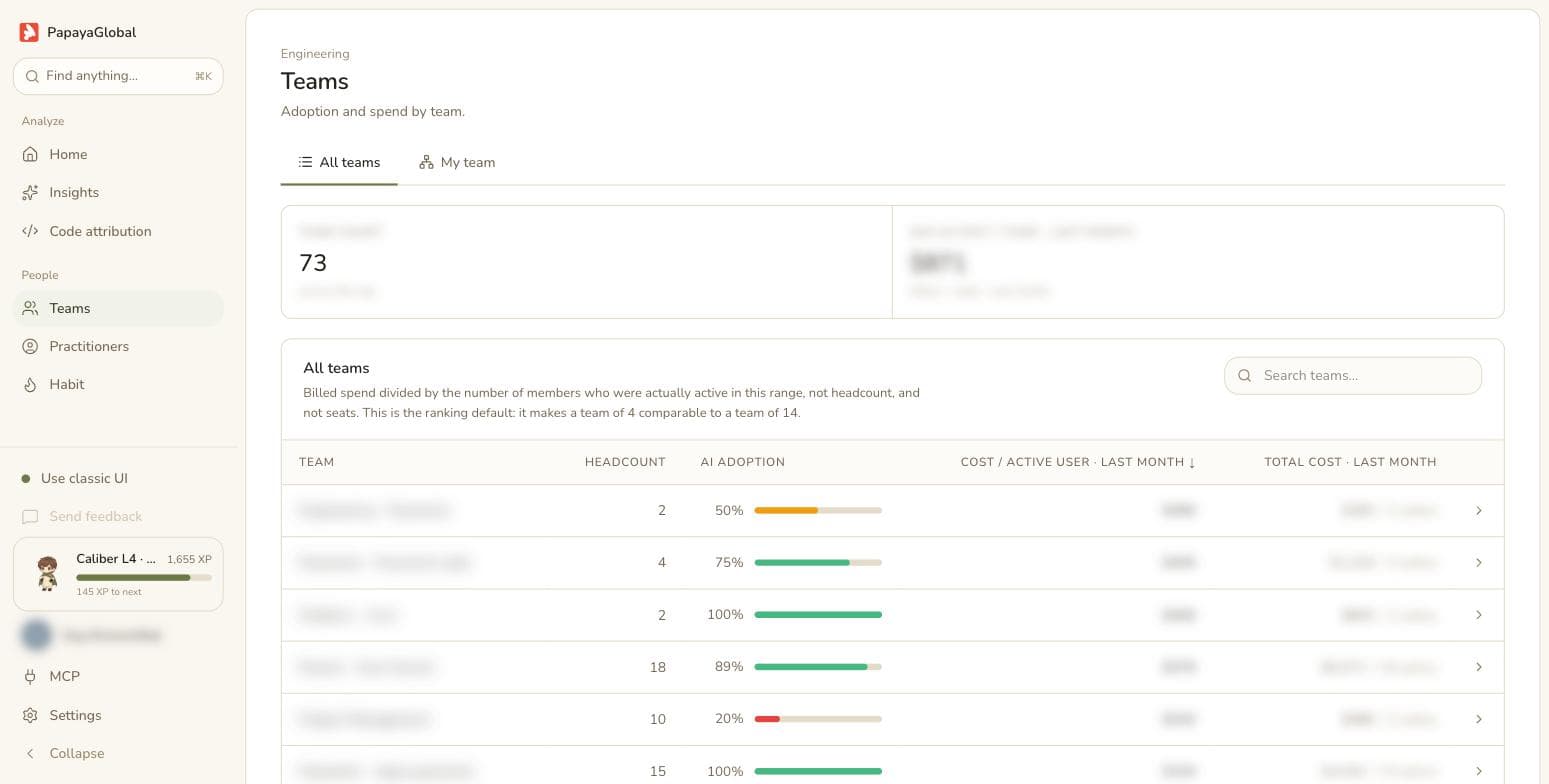
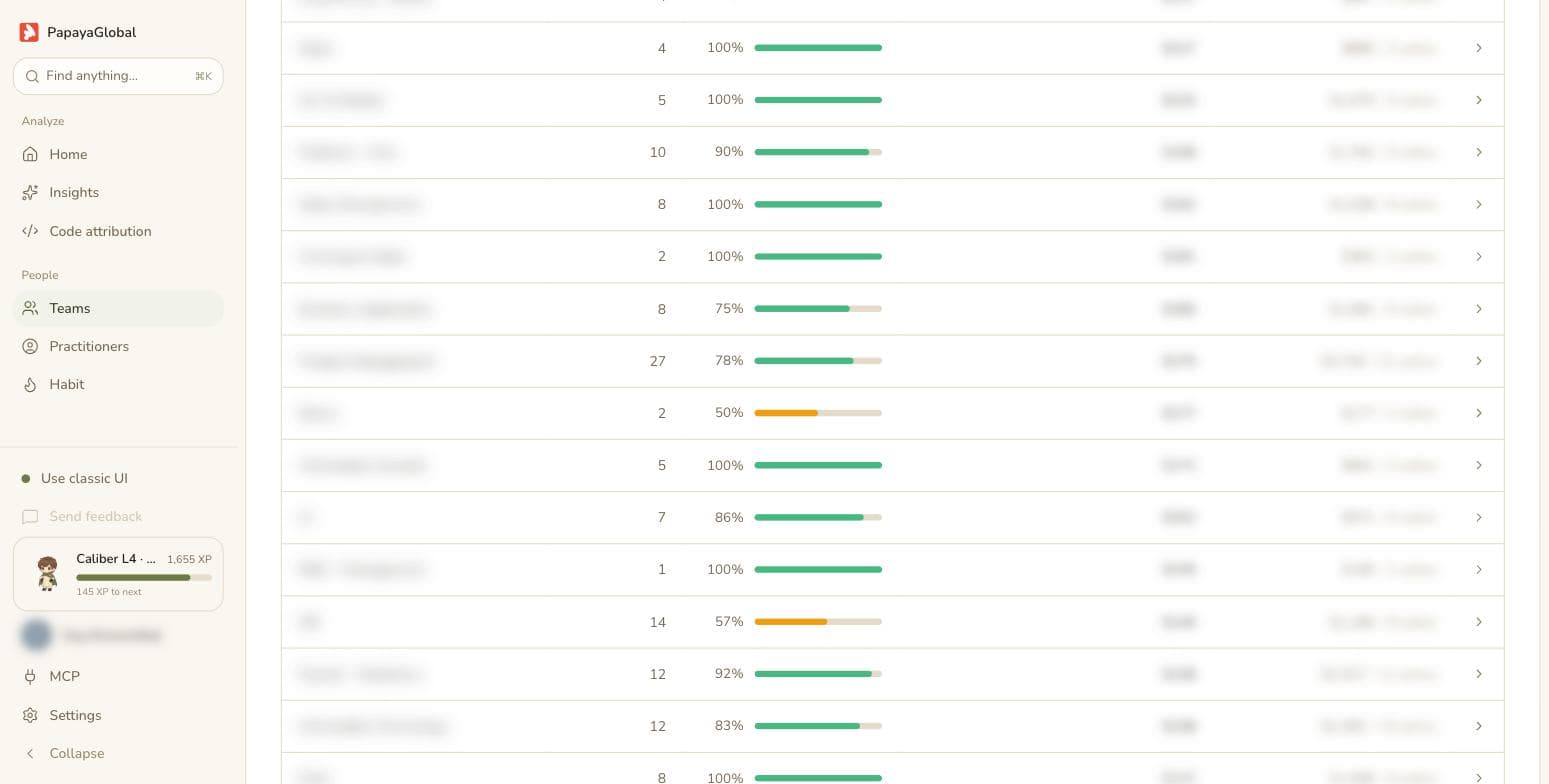
Teams: adoption and cost per active user, engineering or not.

Teams: adoption and cost per active user, engineering or not.

02The town square

Ask a business question. Get the answer.

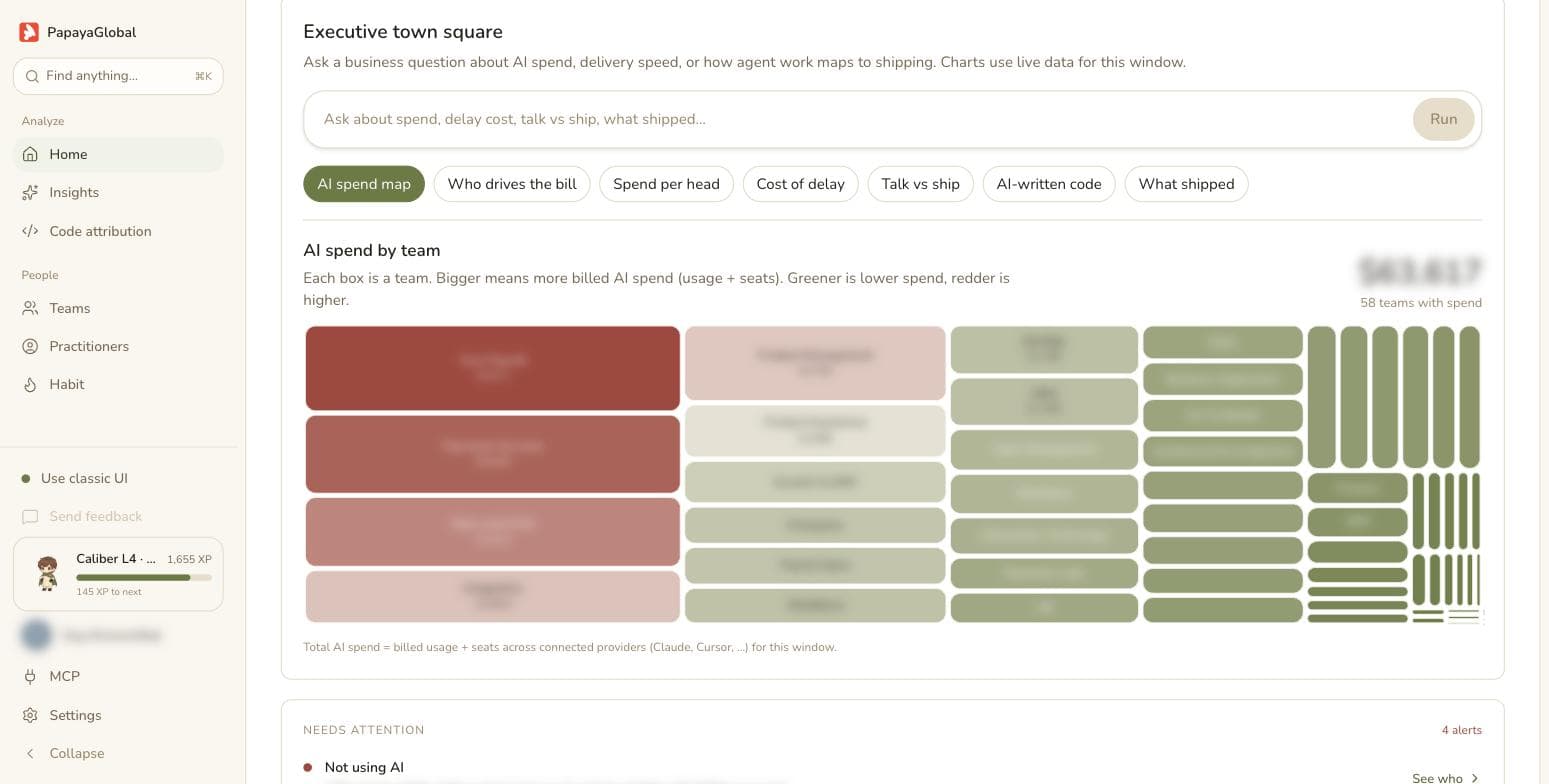
The Executive town square sits on the home screen. Type the question the way you would say it. Seven it answers on sight.

AI spend map: the town square's answer

The Executive town square on Papaya Global's home screen, names and figures redacted. Sources: Claude, Cursor, Jira, GitHub, your HRIS.

03The accountability layer

Agents, keys and usage, assigned to teams and people.

Every agent, API key and Bedrock account has an owner on the org tree, so its usage rolls up to the person, the team and the department. A policy travels with it. A budget caps it. When the budget runs out, the key stops.

API key registry

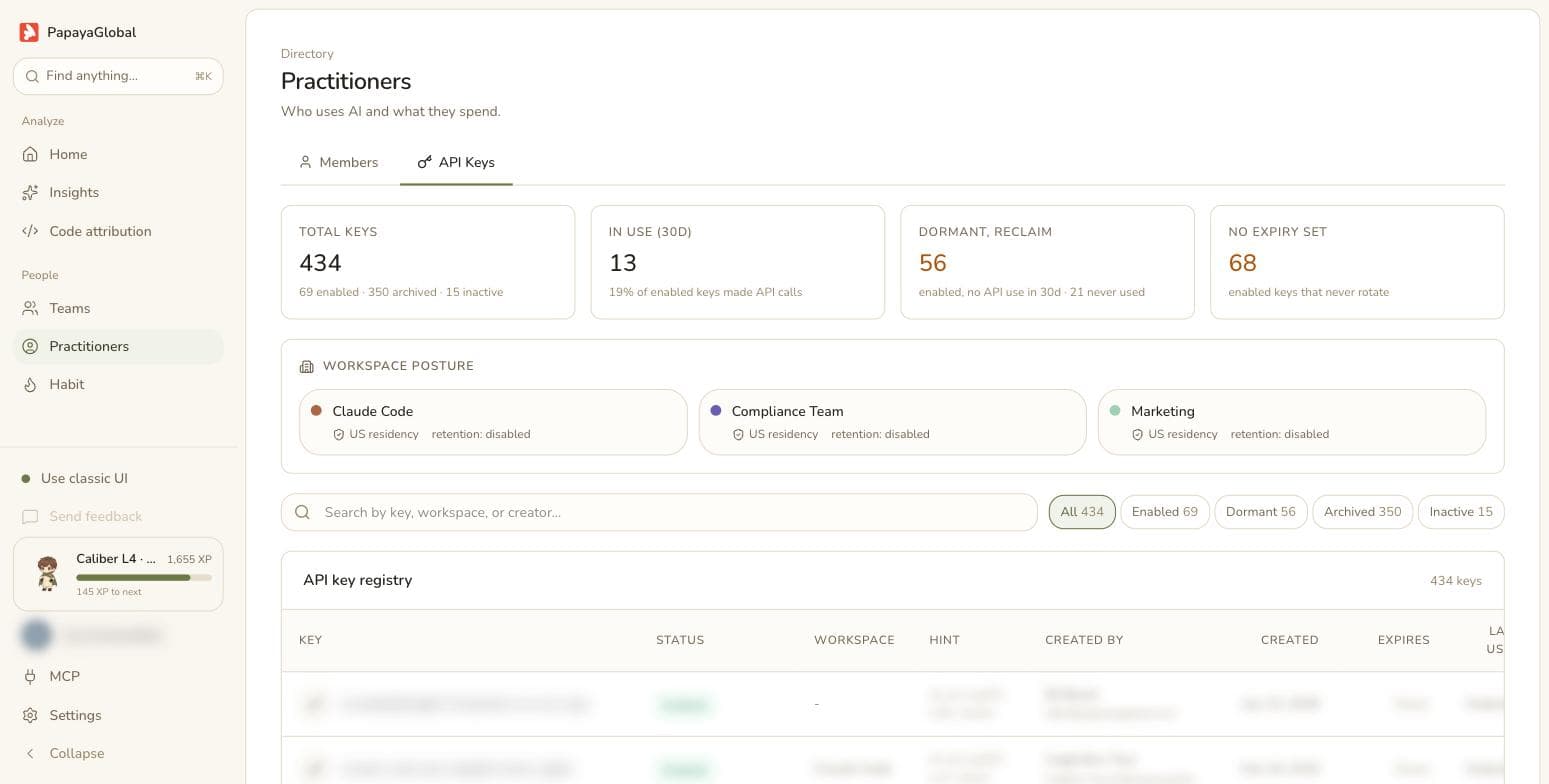
The API key registry: total keys, in use, dormant, no expiry, workspace posture

434 keys. 13 in use. 56 dormant, to reclaim. 68 with no expiry. Each with an owner, a workspace and a posture.

Enforcement

    Metadata, never transcripts. A lead sees that a session ran long and why, never the words.

    04The platform

    The platform, screen by screen.

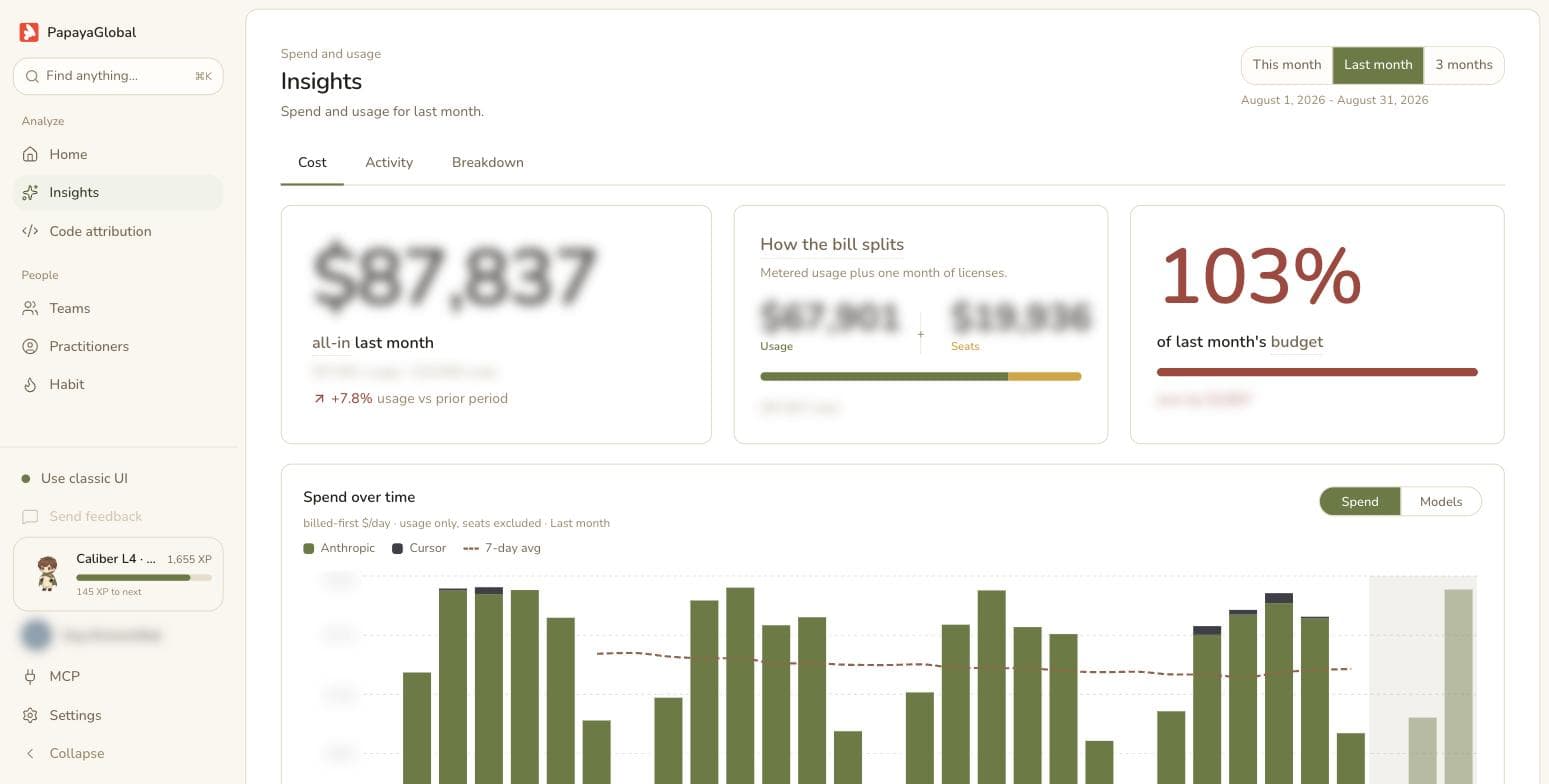
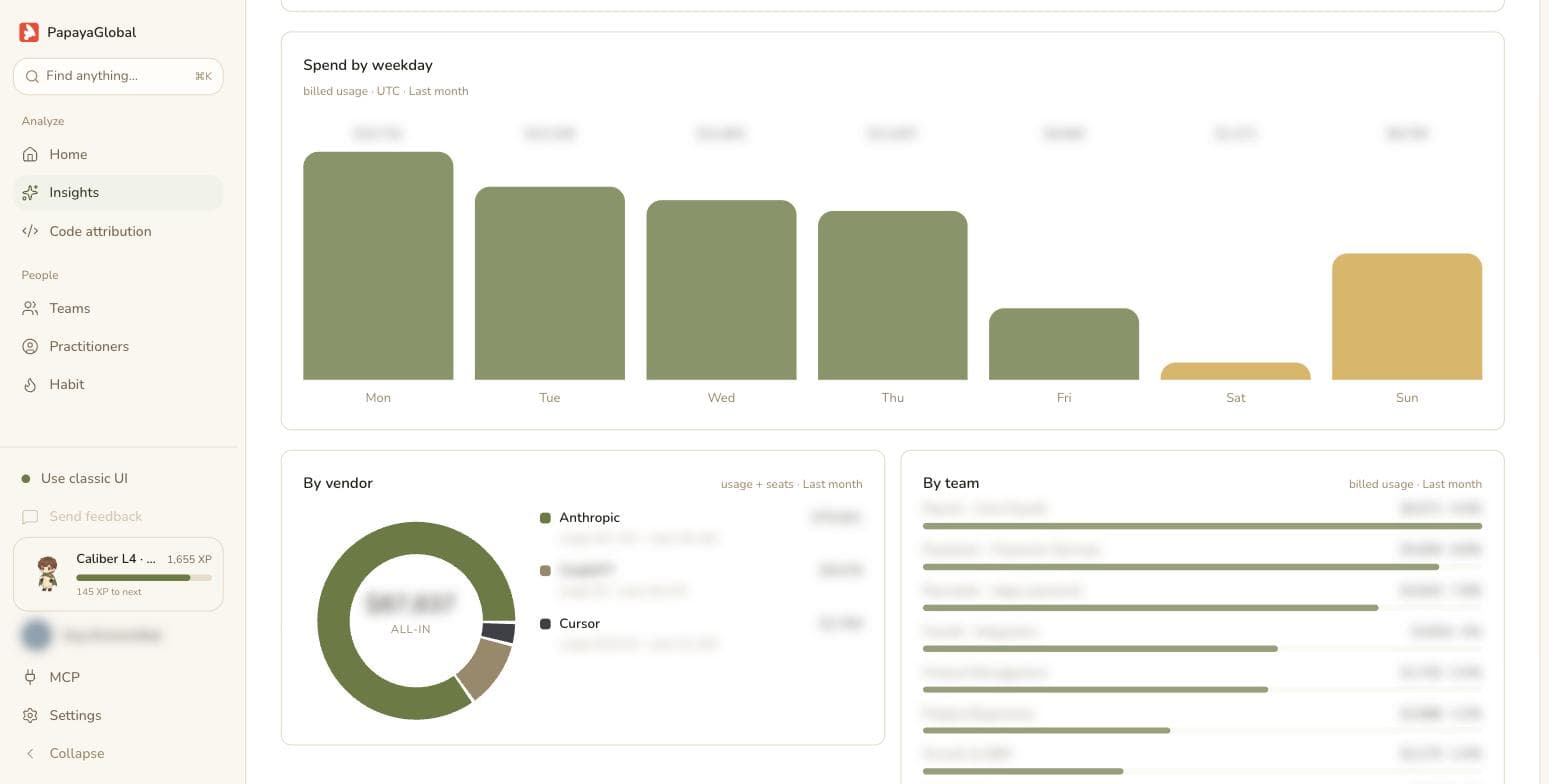
    • Spend and usage: All-in, usage against seats, against budget.

      Spend and usage

      All-in, usage against seats, against budget.

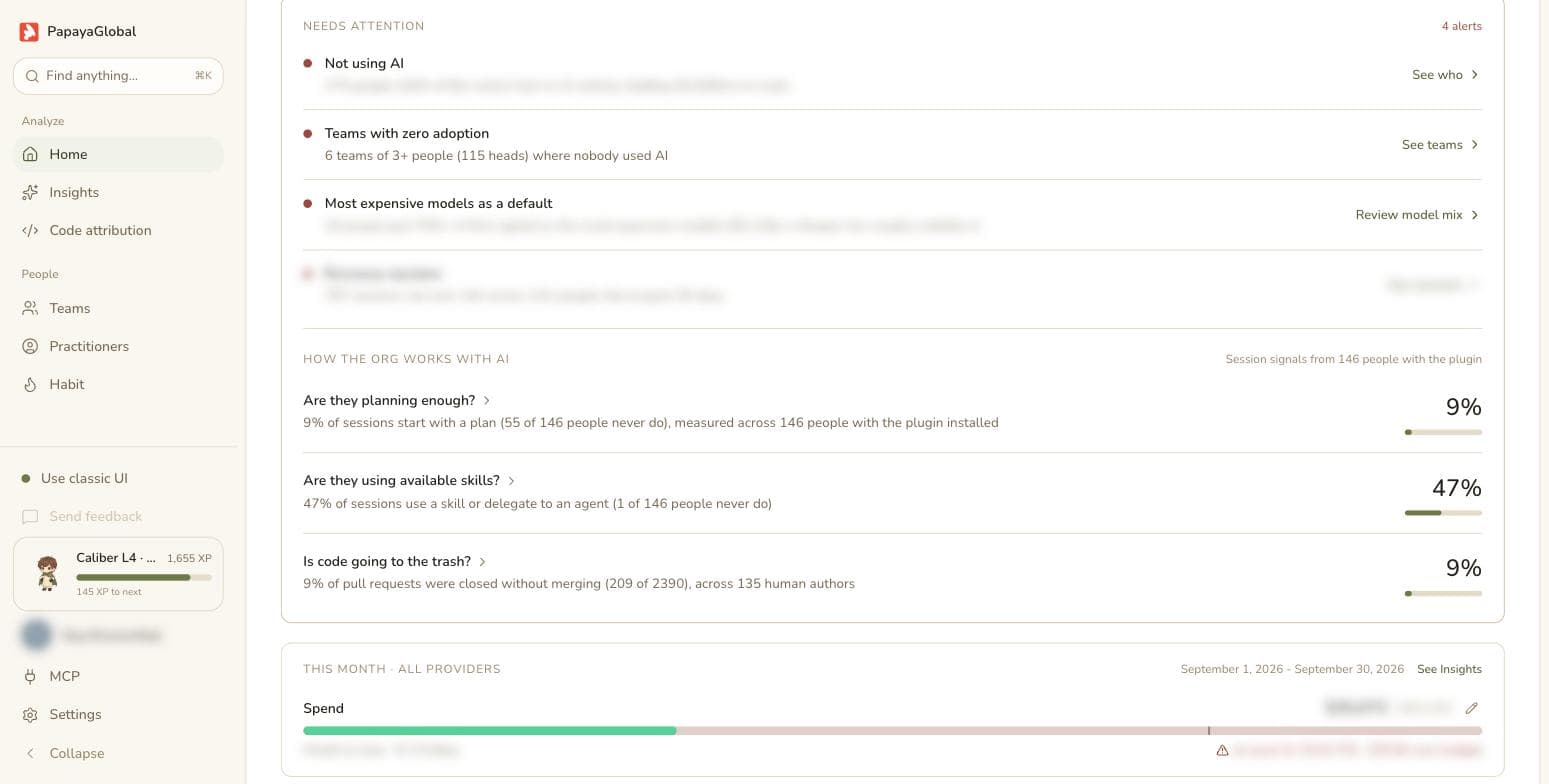
    • Needs attention: Four alerts, each with a next move.

      Needs attention

      Four alerts, each with a next move.

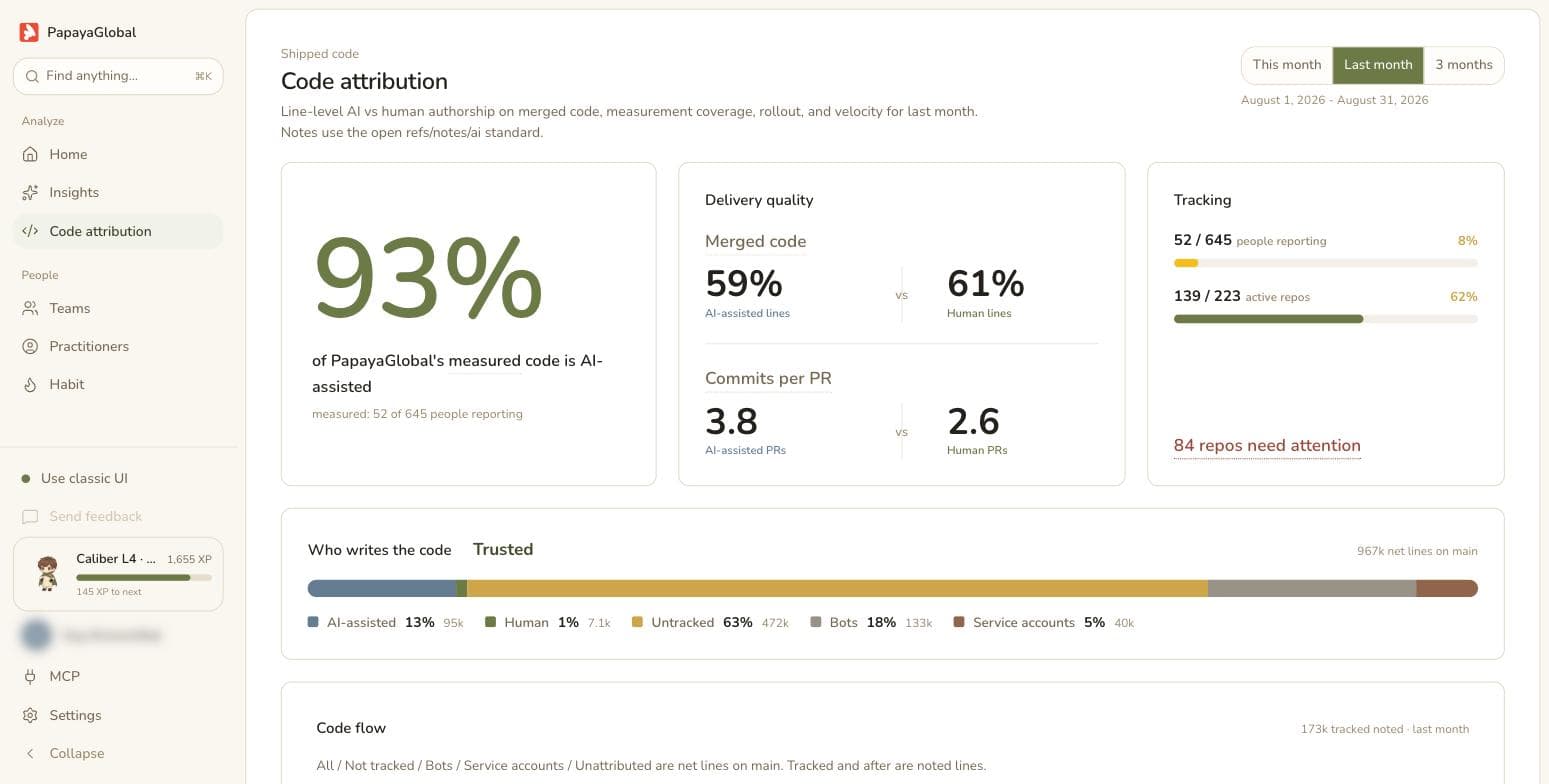
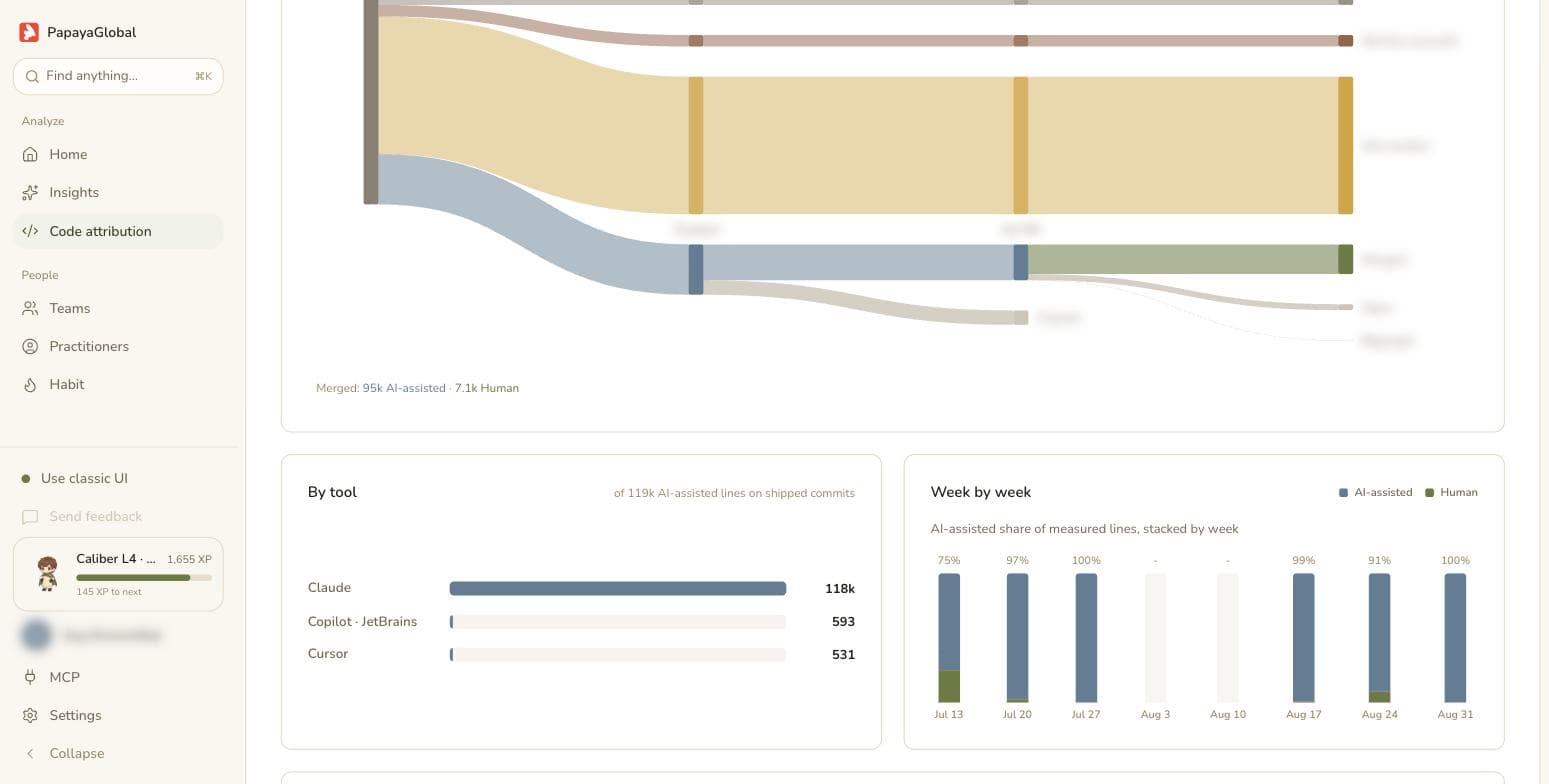
    • Code attribution: Line-level AI versus human on merged code.

      Code attribution

      Line-level AI versus human on merged code.

    • Every team: Adoption and cost per active user.

      Every team

      Adoption and cost per active user.

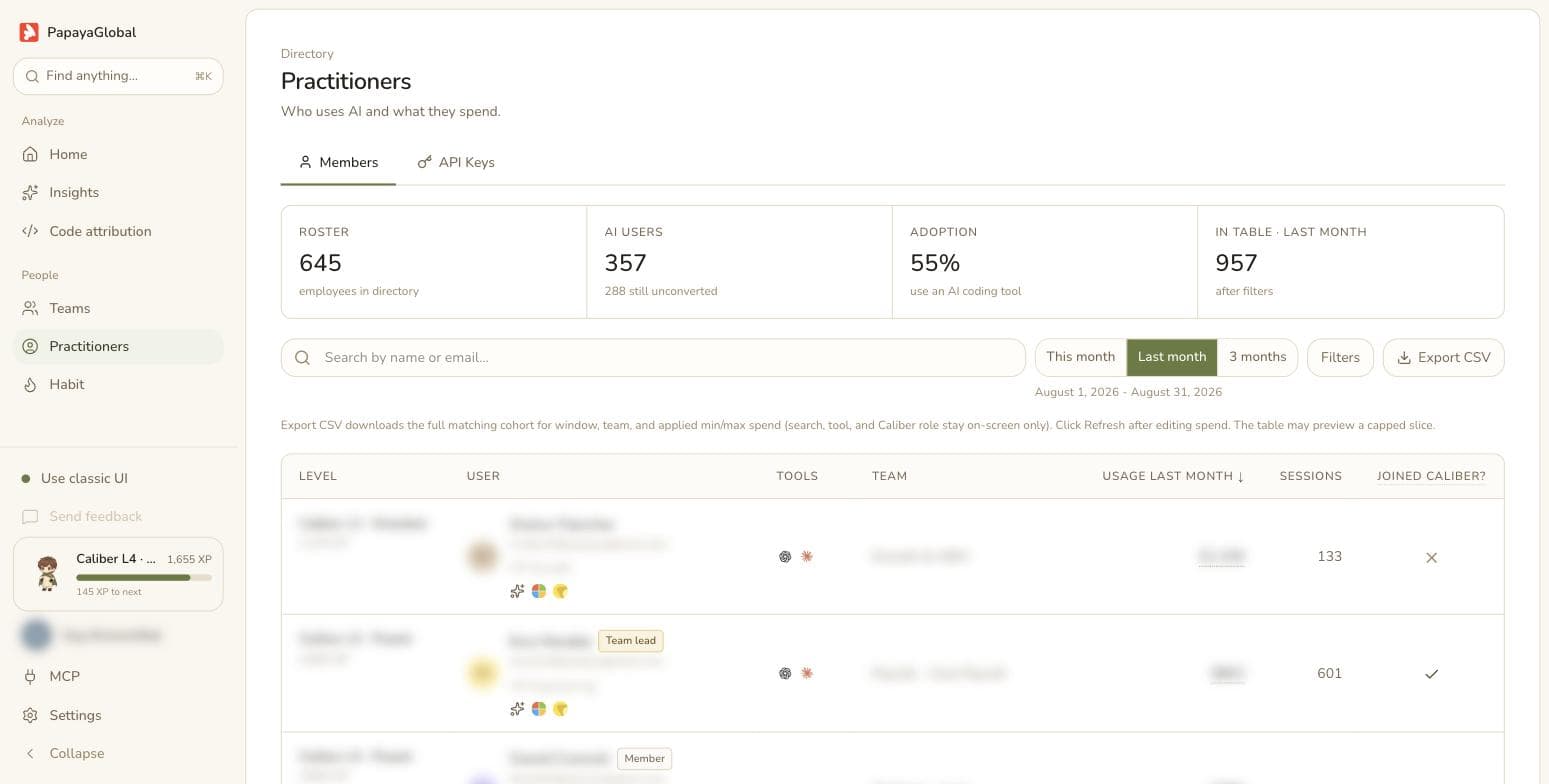
    • Practitioners: Who uses AI, what they spend, their level.

      Practitioners

      Who uses AI, what they spend, their level.

    • By vendor, by team: Where the money goes.

      By vendor, by team

      Where the money goes.

    • Code flow: Tracked, noted, merged.

      Code flow

      Tracked, noted, merged.

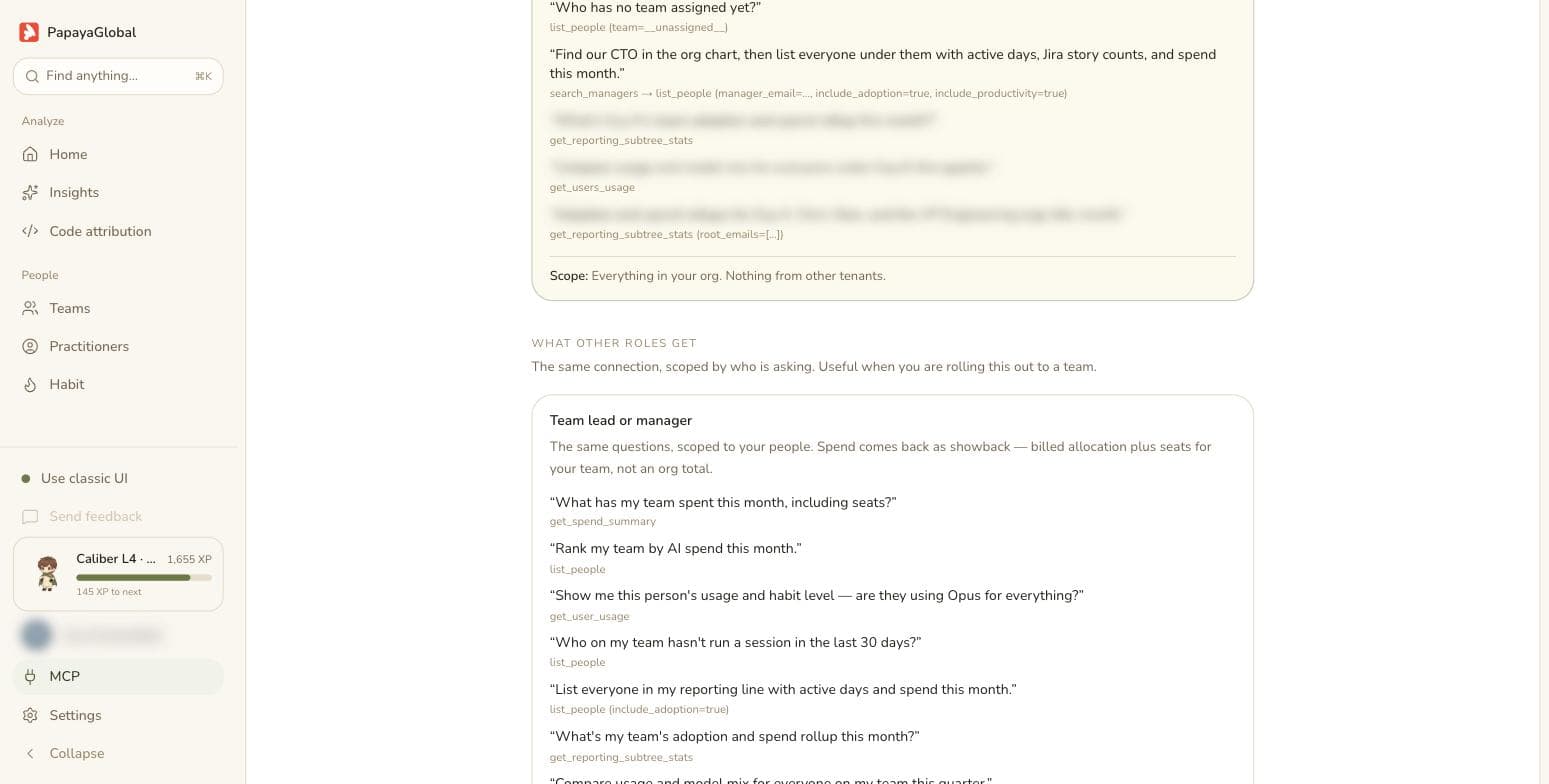
    • MCP, by role: What a lead or a person may ask.

      MCP, by role

      What a lead or a person may ask.

    Real screens from the Papaya Global instance, names and figures redacted.

    In the field

    What Caliber brings, customer by customer.

    Papaya Global · fintech · 1,500+ people

    Executives use it daily. 391 employees get real value.

    • Four AI services on a single integration, per-developer observability
    • 26 idle seats surfaced and moved to the teams that open them, instead of bought
    • +11% items closed vs baseline - one EM shipped 5 Jira issues in 7 days and can see he is ahead of 86% of the org

    Without you guys, I would need a team of ten AI engineers for this.

    Natali Shtulman, Head of AI Enablement

    Toka · software · engineering org

    50% more tickets shipped.

    • 37% fewer production bugs with a context layer on the Git and pipelines they already run
    • Support solves tickets solo, with full customer context in every prompt
    • One engineer's brain first, then the team's, then the company's - always current, permission-aware

    Having a unified, permission-aware context layer was our missing pillar for AI enablement.

    Moty Zaltsman, CTO

    Classified defense unit · the rest redacted

    3,000+ engineers using AI responsibly.

    • One of the most security-constrained environments in the country
    • Governance in place, walleting in place
    • Hands-on with a select AI leadership team - scale, safely, no shortcuts
    Read the customer stories

    Security

    Built for teams that cannot afford compromise.

    Single sign-on and role-based access from the systems you already run. Your data stays where it is, and your team is live inside a week.

    Your cloud

    Runs in your VPC, air-gapped if you need it. Your data never reaches us.

    SSO

    Microsoft Entra ID, SAML and OIDC. Role-based access from the org chart.

    Roster from your HRIS

    HiBob, BambooHR, Shapes. Titles map to roles on their own.

    Pointers, not copies

    Nothing is duplicated into a vendor index. Every pointer resolves against the permissions that person already has.

    Metadata, not transcripts

    A lead sees that a session ran long and why. A lead cannot read the session.

    Isolation that fails loudly

    A guard at boot refuses to start if any tenant table is missing its row-level policy.

    Ask about enterprise